Politics
Mayor Brandon Johnson Launches Reelection Campaign, Vowing ‘We Can’t Go Backward’
Video: Mayor Brandon Johnson joins “Chicago Tonight” on Sept. 14, 2026. (Produced by Blake Thor)
Mayor Brandon Johnson launched a bid for reelection on Sunday, asking Chicago voters to send him back to City Hall for another four years after he spent his first term battered by outside events and suffering from self-inflicted wounds.
Ahead of his announcement, Johnson told WTTW News that deciding to run for reelection was not a tough decision, saying he is determined to build on what he called the considerable accomplishments of his first term.
“We can’t go backward,” Johnson said, accusing his rivals of wanting to close schools and “militarize our streets.”
Illinois Secretary of State Alexi Giannoulias is one of several candidates for mayor to vow to hire 1,000 more police officers. Giannoulias has also said he is prepared to close schools with too few students.
In a video posted early Sunday morning, Johnson vowed to make life in Chicago more affordable and promised “we are just getting started.”
Four years ago, we promised to build the safest most affordable city in America by investing in people. Together we’ve made progress on delivering a better, stronger, and safer Chicago and our work is not done. Join us! pic.twitter.com/wopmJcP4gw
— Brandon Johnson (@Brandon4Chicago) September 13, 2026
The second Black man to be elected mayor, Johnson said the mayoral contest would pit the “corporate class” and billionaires against the “working class” — and that he was proud to fight on the side of Chicago residents struggling to make ends meet at a time when everything from rent and gas to healthcare and groceries are growing more expensive by the day.
But Johnson acknowledged that if he wins a second term in office in 2027, he will have to do it the same way he won the first time: as an underdog.
When he announced he would run for mayor in October 2022, Johnson said he had a theory of how Chicago government could work to make it the “safest, most affordable big city in America,” a refrain he rarely misses an opportunity to invoke when addressing Chicagoans or the news media.
“Now we know it works,” Johnson said, acknowledging he had endured “bumps and bruises.” “But our values were more threatening to the establishment than we thought.”
Johnson said he was prepared to fight for the chance to fulfill his promise to remake the city into a “Chicago for all” — not just the wealthy or the powerful, conceding that there is more work to be done.
“We need more mental health clinics, we need to repurpose more closed schools,” Johnson said, promising to focus on improving Chicagoans’ quality of life in a second term.
Johnson formally kicked off his campaign Sunday afternoon at the DuSable Black History Museum in Washington Park on the city’s South Side.
“By 2031, I want Chicago to be a city where a job pays enough to raise a family in this city,” Johnson said. “I’m talking about a city where the schools that were closed are transformed into assets for the communities that were harmed when they closed them in the first place. These are not just dreams, you all. This is what our organizing is for. This is what we are building for.”
Delayed by rain, Johnson’s campaign staged the announcement as a block party, complete with thumping house music and tacos from a food truck, that drew hundreds of supporters.
“Real transformation has never come from the top down, but from the bottom up,” Johnson said, taking the stage after more than a dozen supporters praised his leadership. “And while we’ve had some disagreements, and the road traveled has not always been smooth, we’ve always come back together.”
Alds. Jason Ervin (28th Ward), William Hall, Jeanette Taylor (20th Ward), Byron Sigcho-Lopez (25th Ward), Jessie Fuentes (26th Ward), Walter “Red” Burnett, (27th Ward), Chris Taliaferro (29th Ward) Rossana Rodriguez-Sanchez (33rd Ward) and Anthony Quezada (35th Ward) attended the event.
Johnson criticized what he called the “corporate media” for attempting to “reduce my first term to a series of overlapping crises,” citing the historic influx of migrants and asylum seekers to the city and President Donald Trump directing his ire at the city.
Johnson touted his push to phase out the tipped minimum wage and ensure that Chicago workers get at least 10 days of paid time off, major priorities for Chicago’s progressive political community.
“It’s important to acknowledge that progress has been made, because this city is better, stronger, and safer than what I inherited,” Johnson said.
Read More: Who Is Running, or Thinking About Running, to Become Chicago’s Next Mayor
A former member of the Cook County Board of Commissioners, Johnson lives in Austin with his wife and two children, who attend Chicago Public Schools. His oldest son started college this fall.
Seven major challengers have already announced bids to challenge Johnson’s reelection bid: Giannoulias, Illinois Comptroller Susana Mendoza, U.S. Rep. Mike Quigley, businessman and philanthropist Willie Wilson, Chicago Housing Authority Board Member Matt Brewer, lobbyist John Kelly Jr. and Cook County Board of Review Commissioner George Cardenas.
Giannoulias’ campaign blasted Johnson’s management of City Hall on Sunday, posting a new digital advertisement promising more competent leadership.
All will seek to make the election a referendum on Johnson and his leadership of the crises that have shaped his time in office: the arrival of more than 46,000 migrants, the return of President Donald Trump to power and his decision to send hundreds of federally armed agents to Chicago as part of an effort to carry out mass deportations of undocumented people.
“Here’s the truth: he couldn’t break us,” Johnson said of the president, who called for him to be jailed, and attempted to deploy the National Guard to Chicago.
Johnson frequently reminds reporters that other Democratic leaders followed the path that he blazed by issuing a series of executive orders that banned federal immigration agents from city-owned property, sought to protect the right of residents to protest federal agents’ actions and urged local law enforcement officers to probe agents’ conduct.
Johnson will also center the significant and sustained drop in violent crime in Chicago during his time as mayor during his campaign, pointing to it as evidence that his focus on the root causes of crime and violence by increasing funding for youth employment programs and expanding mental health services is more effective than expanding the Chicago Police Department and making more arrests.
In 2025, the number of Chicago homicides hit a 60-year low, where they have remained for more than a year, according to CPD data. In addition, the city’s overall violent crime rate decreased by 7.6% so far this year as compared with 2025, after dropping more than 20% in 2025, as compared with 2024, according to CPD data.
Johnson also touted his successful push to reinstitute the Department of the Environment, which was shuttered by former Mayor Rahm Emanuel.
But his proposal to allow city officials to weigh the amount of existing air, water and soil pollution in a community — not just what a proposed project is expected to add if it is approved — when considering allowing additional polluting industries never even got a vote.
In addition, Johnson has failed to fulfill a promise to put an end to what he called “literal sacrifice zones” — neighborhoods home to Black and Latino Chicagoans where industrial firms are allowed to pollute the air, water and soil with impunity, making residents sick and degrading their quality of life.
Protecting Chicago’s environment and infrastructure as the number of intense storms fueled by climate change increases will be a major priority if he is reelected, Johnson said.
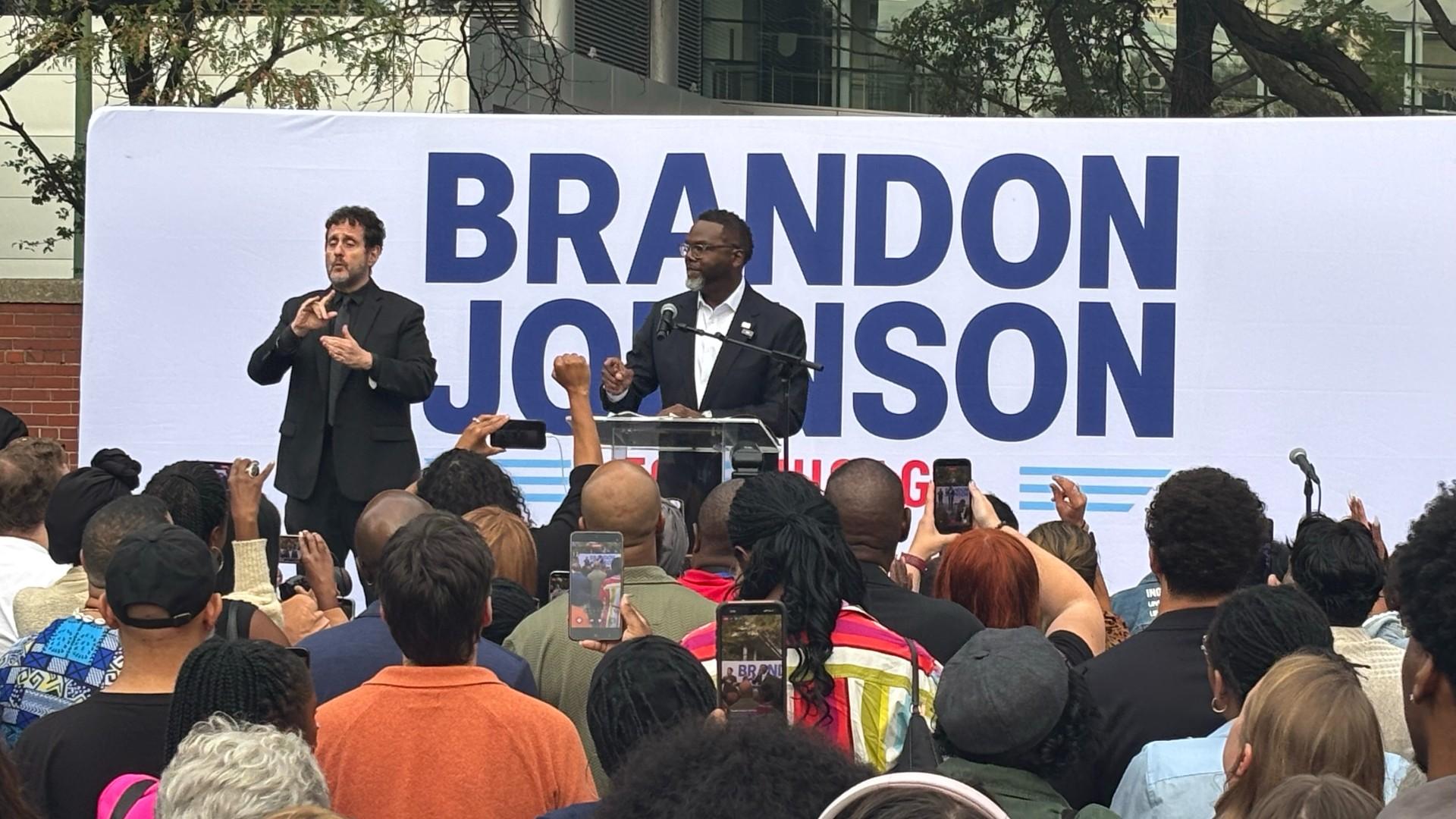 Mayor Brandon Johnson launches his campaign for a second term on Sept. 13, 2026. (Heather Cherone / WTTW News)
Johnson, a former middle school teacher and union organizer, is expected to win the backing of the Chicago Teachers Union and the Illinois Federation of Teachers, both led by Stacy Davis Gates, a close ally of Johnson.
In November, Chicago voters will go to the polls to elect every member of the Chicago Board of Education for the first time in history. That will force CTU and its allies to quickly mobilize supporters — and contributors — for the mayoral and aldermanic contests just weeks after the school board election.
In addition, it is not clear whether the Service Employees International Union Local 73 and SEIU Healthcare Illinois will back Johnson again during this election, as they did in 2023, amid a bitter fight with CTU over which union some CPS employees, including tutors and recess monitors, should belong to.
The city’s trade unions — including Chicago Laborers District Council, the International Union of Operating Engineers Local 150 and the Mid-America Carpenters Regional Council — are backing Giannoulias in the mayoral contest.
Those unions backed U.S. Rep. Jesús “Chuy” Garcia in the first round of the 2023 election and then former Chicago Public Schools CEO Paul Vallas in the runoff.
Johnson, who was outspent by a nearly two-to-one margin by Vallas in 2023, is likely to be massively outspent again, this time by Giannoulias, according to records filed with the Illinois State Board of Elections.
In 2023, Vallas spent $18.6 million, only to lose to Johnson.
Giannoulias, who is simultaneously running for mayor and for reelection as secretary of state had $21.7 million in cash on hand as of June 30, records show. Giannoulias is already blanketing the airwaves with campaign commercials that tout his response to the aggressive immigration raids.
Since then, Giannoulias has reported $835,000 in donations of more than $1,000, records show, which is almost $200,000 more than Johnson had in cash on hand on June 30 and what he has reported taking in since then, records show.
Contributions to Giannoulias include $50,000 from Paul Meister, the vice chairman of GCM Grosvenor, the investment firm led by Michael Sacks, a billionaire who supported former Mayor Rahm Emanuel, who has repeatedly clashed with Johnson.
Johnson on Sunday warned the enthusiastic, if somewhat damp and tired crowd, to be wary of “posers” — those who call themselves progressives on Election Day but aren’t part of the movement that began with Washington’s election and “take money from AIPAC,” the American Israel Public Affairs Committee.
After his announcement, Johnson called the Emanuel administration the “Sacks administration” and defended criticizing him by name, calling him a “source of pain” for Chicago’s working class.
Johnson has blamed Sacks for thwarting his efforts to raise taxes on Chicago’s largest corporations and wealthiest residents to fund critical services and ease the city’s financial crunch.
Johnson criticized Sacks, one of the largest donors to the Democratic Party and AIPAC, by name twice in his half-hour speech.
Noting Johnson’s low approval rating in most polls, Sacks told WTTW News in a statement that the mayor “needed some better dance moves.”
“It’s telling that Mayor Johnson is going with a disingenuous campaign of defamation and lies rather than his record, but I guess I should be proud to be in the good company of Mayor Harold Washington and Secretary of State Alexi Giannioulias at the top of Johnson’s mind,” Sacks said.
The first day for candidates for mayor to file at least 12,500 signatures with the Chicago Board of Election Commissioners to qualify for the ballot is Oct. 19. The final day to file is Oct. 26.
The offices of city clerk, city treasurer, all 50 Chicago City Council members and 66 Police District council members will also be up for grabs.
Election Day is set for Feb. 23 — unless no candidate gets 50% of the vote plus one. In that case, the top two candidates head to the runoff on April 6.
Note: This article was published Sept. 13, 2026, and updated with video Sept. 14, 2026.
Contact Heather Cherone: @HeatherCherone | (773) 569-1863 | [email protected]